
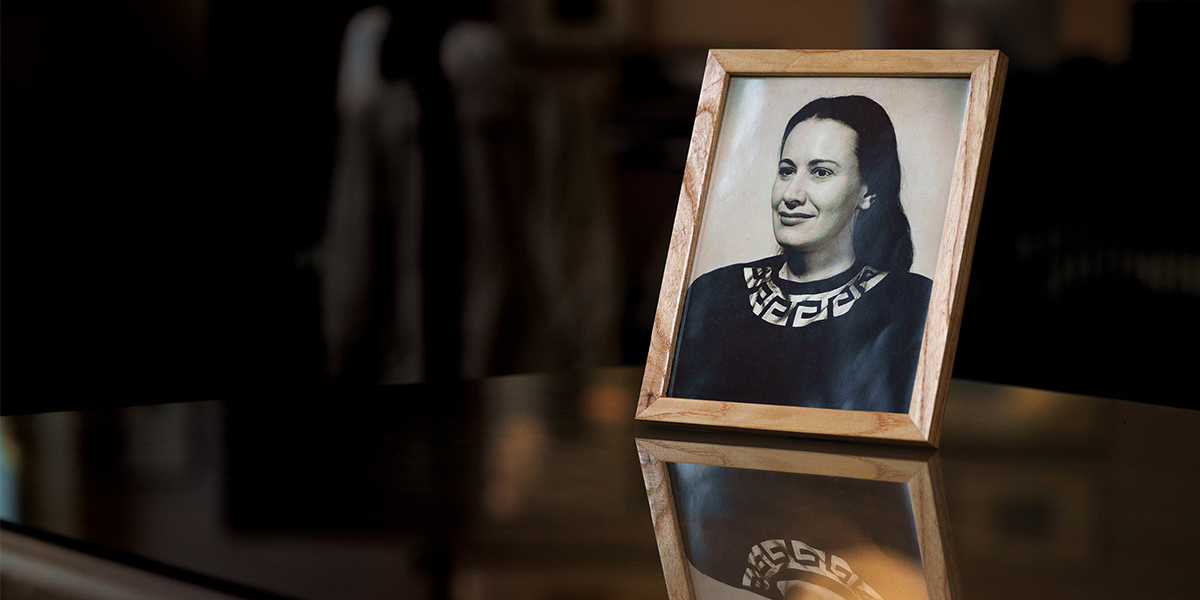
Harriet Bouslog liked to get into good trouble – even to the point that it caused her a yearlong suspension by the Hawai‘i Bar Association for exercising her First Amendment rights.
A champion for laborers and underrepresented communities, Bouslog was a fearless, outspoken lawyer who had many firsts: she was the first to become general counsel for the International Longshore and Warehouse Union (ILWU); and she was the first to establish free legal counseling – long before the Legal Aid Society.
Bouslog was licensed to practice law in Hawai‘i on Dec. 23, 1941. However, the attack on Pearl Harbor 16 days earlier had triggered martial law and Hawai‘i courts closed, putting her out of business.
She went to work for the National War Labor Board in Washington, D.C., and at the end of the war, Bouslog was asked by ILWU founder Harry Bridges and the union’s then-leader, Jack Hall, to return to Hawai‘i to defend the workers who were imprisoned for striking against plantation owners.
“Harry knew that Harriet was allowed to practice law in Hawai‘i since he had dealings with her as an ILWU lobbyist in Washington, D.C.,” said Mark Bernstein, who was convinced by Bouslog to move to Hawai‘i in 1979 to join her practice.
“Before she got on a plane to Hawai‘i, Harry said to her, ‘You know, Harriet, I promised them all that you wouldn’t let any of them stay in jail. Don’t make a liar out of me.’”
She didn’t.
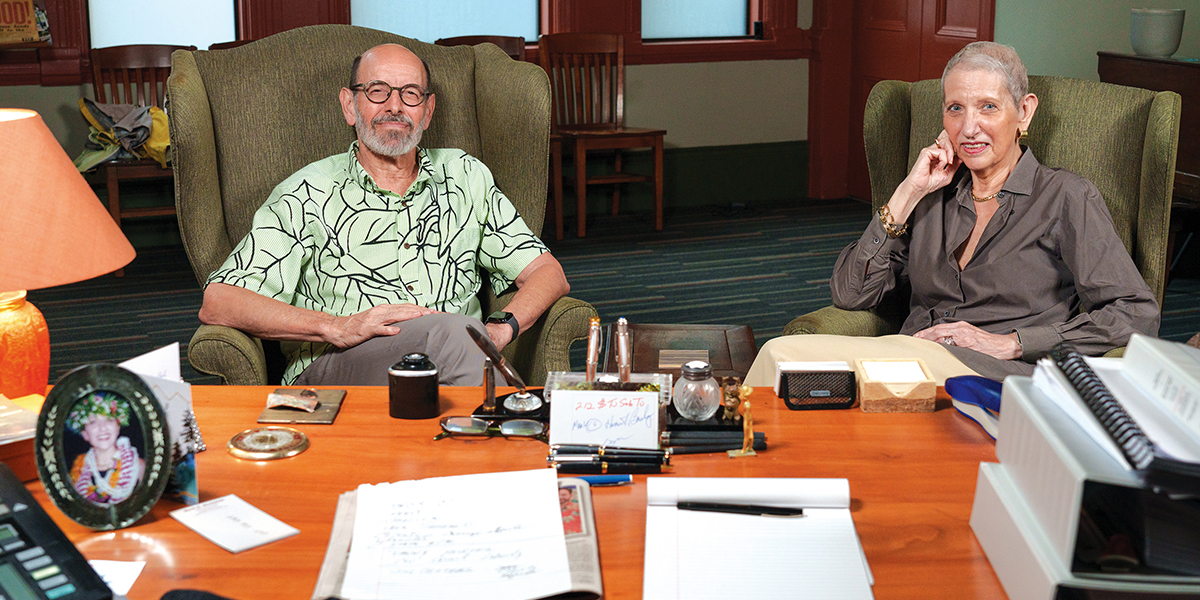
Sitting at a conference table in front of Bouslog’s desk in her original office on the corner of Merchant and Bethel streets, Mark and Leah Bernstein spoke candidly about Harriet and her progressive politics during a time when there were very few female attorneys across the country, and only a handful in the state.
In 1952, she gained notoriety when she represented the “Hawai‘i 7,” who were labor organizers and civil libertarians, in their trial for allegedly conspiring to overthrow the U.S. government.
The charges were brought under the Smith Act: a statute that allowed the government to try to break unions by arresting their leaders and alleging they were Communists conspiring against the U.S. government.
During the case of In re Sawyer, Bouslog was accused of “impugning the integrity” of the trial judge by publicly criticizing the government’s handling of the Smith Act cases. In a fiery speech to ILWU members in Honoka‘a on Hawai‘i Island, Bouslog rebuked the prosecution, the FBI and the state of the law.
Investigated for her behavior and inflammatory remarks, Bouslog was charged with contempt for engaging in a willful attack on the federal district court and, by implication, she had disrespected presiding Judge Jon Wiig. The Territorial Supreme Court disbarred her for a year as punishment.
Not one to cower away from a fight, Bouslog appealed her suspension and took the case all the way to the U.S. Supreme Court, which in a 5-4 vote ruled in her favor. The 1959 ruling would set a landmark precedent for lawyers: the right to speak publicly and to criticize the government within the canons of ethical conduct.
“And that’s why today lawyers are allowed to go on television and talk about their cases,” said Bernstein whose mother, Florence Bernstein, was a Los Angeles judge and a good friend of Bouslog’s. “One day Harriet was watching Court TV, and she said that in hindsight, maybe that wasn’t her greatest victory.”
Contemporary observers may view aspects of Bouslog’s life as paradoxical. Author Mari Matsuda best captured the essence of Bouslog when she wrote: “She dressed like Bacall and fought like Bogart. She called the plantation workers ‘my people,’ but she enjoyed the trappings of the good life.”
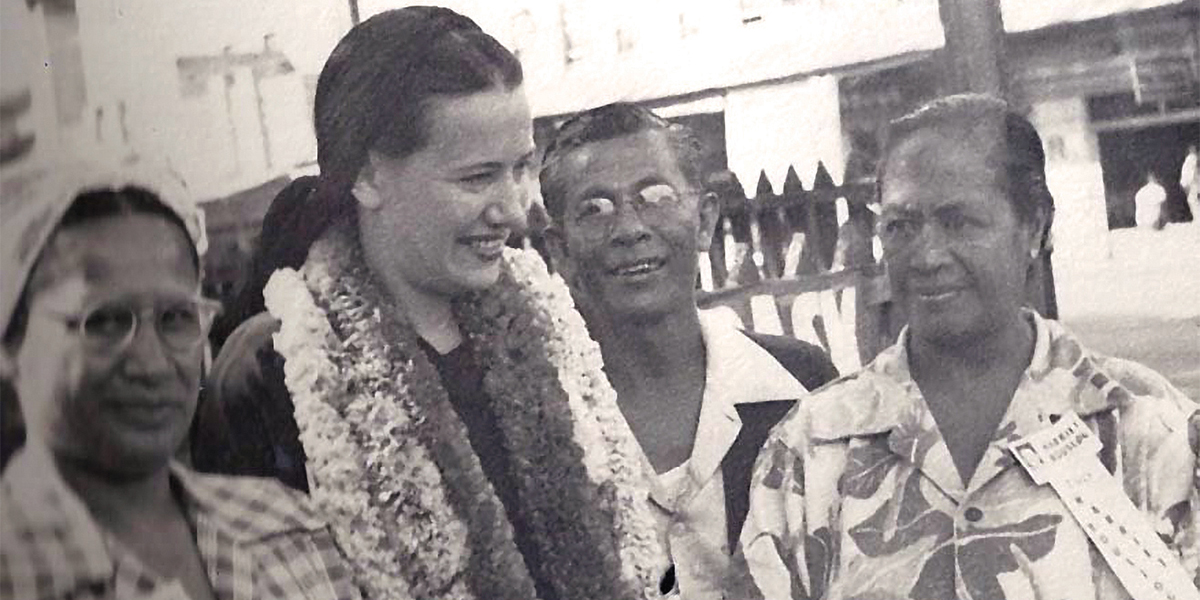
“She was a walking contradiction,” Leah Bernstein said. “She would strut down Merchant Street on the way to the courthouse in a tight skirt with a slit along her leg. She was a beautiful woman who loved Champagne and attending cocktail parties.”
During one of those soirees, Bouslog learned about the 1948 Wilder murder case against James Majors and John Palakiko, who, she was told, were days away from being executed. Bouslog immediately sought a stay and succeeded within mere minutes of their executions.
The two young Native Hawaiians’ sentences would later be commuted in 1954 by the new governor, Samuel W. King.
“No one has ever again been executed in Hawai‘i,” Mark Bernstein said. “And by 1957, capital punishment had been abolished.”
Working as the counselor for ILWU 142 brought meaning to Bouslog’s life. She sought equality and fairness for all, believing that every voice deserved to be heard, and every person treated with dignity and respect. To pay the ILWU 142 back, Harriet created the Harriet Bouslog Labor Scholarship Fund to help send the family of ILWU 142 members to the University of Hawai‘i.
The Bernsteins have administered the Harriet Bouslog Labor Scholarship Fund at Harriet’s request and are now working with UH to continue her legacy and fulfill her desire to help ILWU 142 members and their families get an education here in Hawai‘i, and use that education to make our islands a better place to live and work.
“That’s all Harriet ever wanted,” Mark Bernstein said. “She worked tirelessly for this goal.”
Even if it meant she got into good trouble.
Questions? / More Information
If you would like to learn how you can support UH students and programs like this, please contact us at 808-956-8700 or send us a message.