
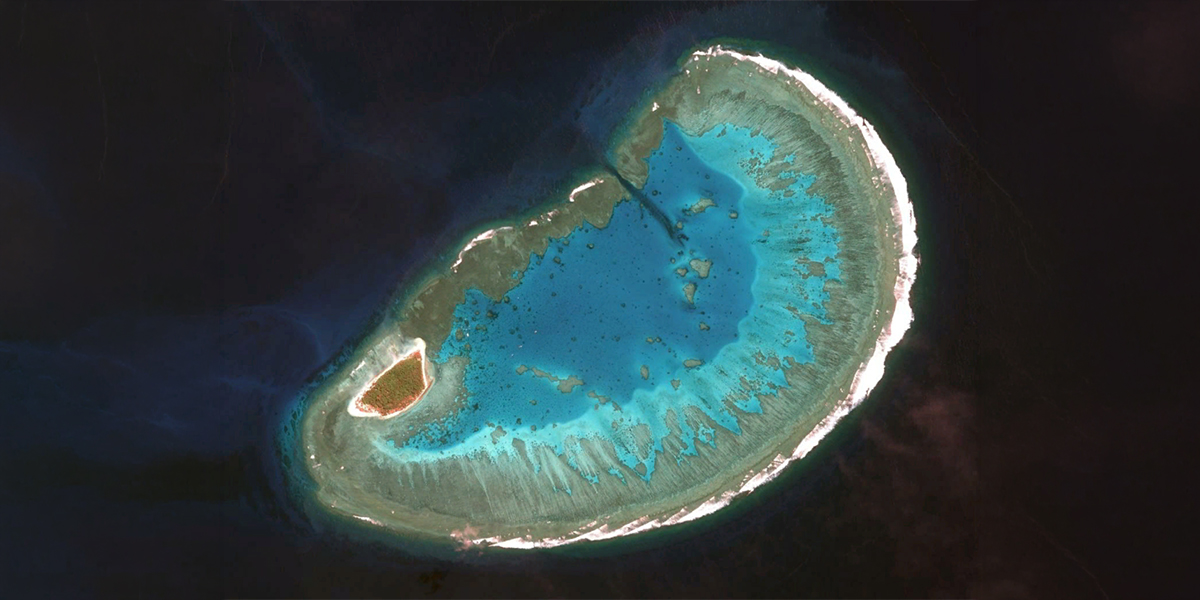
From thousands of feet above the ocean, coral reefs reveal a hidden signal: pale, circular “halos” etched into the seafloor.
For Elizabeth Madin, an associate research professor at the Hawaiʻi Institute of Marine Biology within UH Mānoa’s School of Ocean and Earth Science and Technology, those rings may hold the key to monitoring reef health across the planet, without ever getting in the water.
For decades, marine biologists have relied on scuba diving and snorkeling to assess coral ecosystems. While these approaches remain essential, they can only reach a fraction of the world’s reefs.
“Normally we would go in and survey the fish and the corals underwater, and that is important, and still totally relevant,” Madin said. “But we cannot get to most reefs that way.”
A Serendipitous Discovery in Australia
The breakthrough, however, was sparked from a moment of curiosity.
Years ago, while stationed at Heron Island on Australia’s Great Barrier Reef, Madin and her scientist-husband were sidelined by severe weather that made boat travel impossible. With fieldwork on hold, she turned her attention to the unusual, faint rings she had previously noticed surrounding coral patches.
“I thought, well, we can’t do anything else,” Madin recalled. “So let’s just go wander out to the reef and see what these halos look like underwater.”
What began as a workaround quickly became the beginning of a 14-year research project. Later, viewing reefs through satellite imagery and Google Earth, Madin realized these halos weren’t isolated – they appeared across coral ecosystems worldwide.
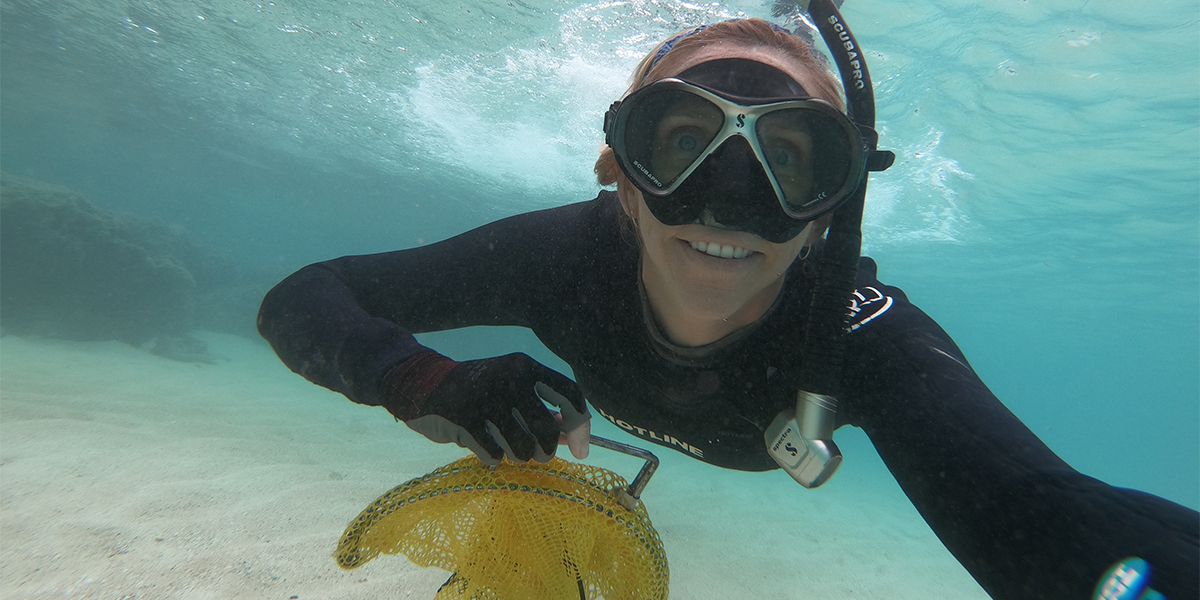 Before taking her research to the skies via satellite imagery, UH Mānoa researcher Elizabeth Madin started by observing "reef halos" underwater.
What the Halos Reveal
These circular halos are not shaped by currents or tides, though water temperature and nutrients in the seawater do play a part. They are created primarily by behavior. Small, plant-eating fish graze on algae surrounding coral reefs but rarely stray far from shelter, where predators can easily reach them. Their caution creates a distinct boundary, a ring cleared of vegetation marking the limit of how far they are willing to venture.
If predator populations decline – often due to overfishing – that boundary can disappear. Emboldened, grazing fish roam farther, and the halo fades.
“If you see halos in a place, it is telling you a couple of things,” Madin explained. “It is telling you that you have enough herbivores and probably also telling you that there are enough predators.”
In other words, the presence or absence of these rings offers a visible signal of ecosystem balance.
From Observation to Global Tool
Recognizing the potential of utilizing these halos as a global monitoring tool, the Paul M. Angell Family Foundation stepped in to fund Madin’s innovative work. An initial grant expanded into a multi-year commitment. Recently, the foundation asked Madin what it would take to turn her research into an impactful tool in the real world, resulting in a substantial two-year grant.
Backed by this vital funding, Madin's dedicated team has already developed a beta version of the software. The platform uses artificial intelligence to scan satellite imagery, automatically detecting if halos are present, determining their locations and measuring their sizes.
By pairing satellite imagery with the instinctive behavior of reef fish, her work offers scientists a long-needed way to take the pulse of coral reefs at a global scale.
In an era when many reefs are under increasing pressure, these halos – visible from space – may serve as an early warning system, helping protect the ecosystems that sustain life below the surface.
“Ultimately, our goal is to grow this into a much larger, independent center,” said Madin, referring to the new Marine Conservation Innovation Group, a merger of her lab and that of her husband, Joshua. “By scaling our work, we can leverage donor partnership to drive conservation solutions with global reach.”
Questions? / More Information
If you would like to learn how you can support UH students and programs like this, please contact us at 808-956-8700 or send us a message.