
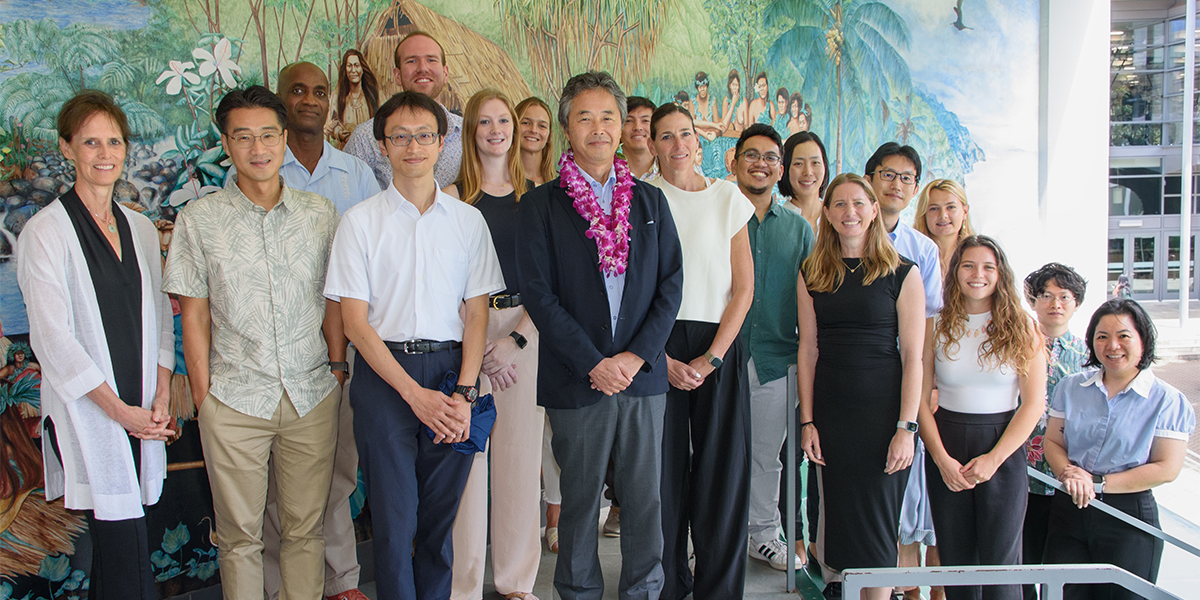
At its core, the work of the Uehiro Center for the Advancement of Oceanography (UC•AO) is not just about science – it’s about people. As ecological imbalances accelerate and ocean health declines, the consequences ripple across every aspect of life: food security, coastal protection, weather extremes, and the economies and cultures of island and coastal communities.
By advancing cutting-edge oceanographic research and building global collaborations, the UC•AO is helping to safeguard the ecosystems that sustain billions of lives. From understanding coral reef resilience to predicting sea-level rise, this research empowers leaders, informs policy and delivers hope.
Established in 2022 through a generous donation from the Uehiro Foundation on Ethics and Education in Tokyo, Japan, the UC•AO is connecting researchers across disciplines and borders to address shifting environmental conditions, protect marine biodiversity and prepare the next generation of ocean leaders.
A Strategic Vision for Impactful Science
Guided by oceanographers Drs. Margaret McManus, Nyssa Silbiger, Hyodae Seo and Sachiko Yoshida, the UC•AO is driving a bold, interdisciplinary agenda that supports real-time, data-driven responses to the planet’s most urgent environmental challenges. McManus, who serves as both Director of the Uehiro Center and Chair of UH Mānoa’s Department of Oceanography, describes UC•AO as “a place where science meets collaboration – where students, faculty and global partners are advancing knowledge and informing smarter environmental stewardship.”
Aligned with the some of the 17 United Nations Sustainable Development Goals – including Climate Action (SDG 13), Life Below Water (SDG 14), Responsible Industry and Innovation (SDG 9) and Reduced Inequalities in Science (SDG 10) – the UC•AO is uniquely positioned to inform ocean policy, support equitable research opportunities and scale solutions that matter.
“The UC•AO is still relatively new so these are exciting times right now,” said Uehiro associate professor and associate director [AT1] Seo. “It’s in the research we’re doing and the connections we’re making that you really see good science come to life.”
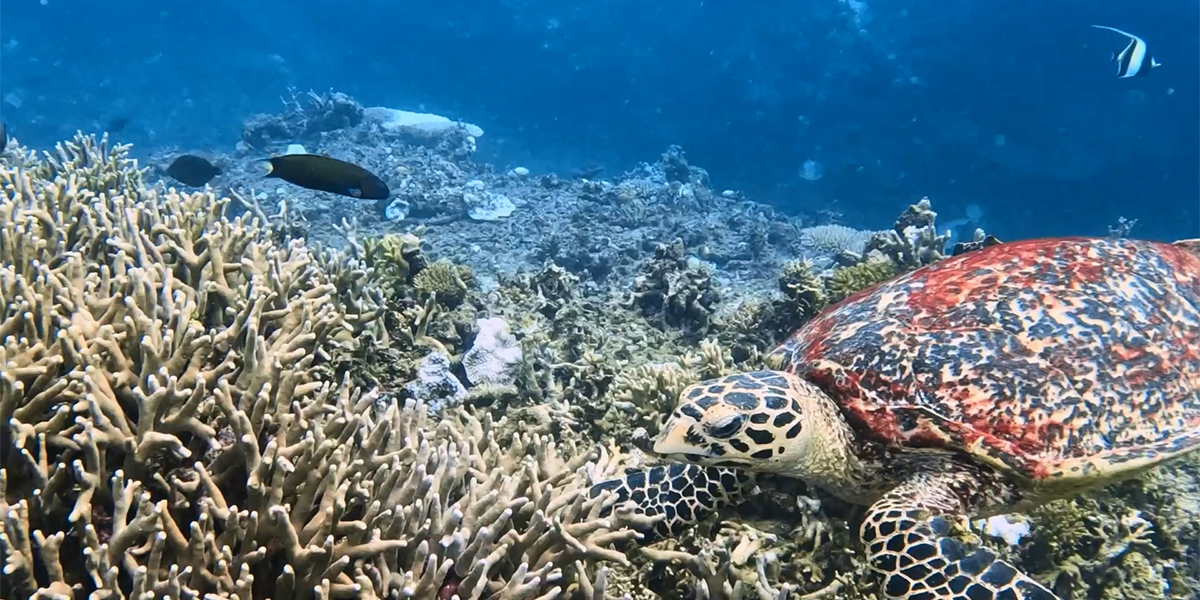 Hawksbill sea turtles inhabit the tropical and sub-tropical waters of all of the world’s major oceans. Courtesy Nyssa Silbiger
Global Collaborations: From the Subtropics to the Subarctic
In 2025, the UC•AO will launch a two-way, cross-cultural and cross-ecological research and education exchange with Hokkaido University in Japan. UH Mānoa and Japanese scientists will work together to study subarctic marine systems in Hokkaido and explore subtropical environments in Hawaiʻi – offering both institutions critical comparative data and experiential learning opportunities focused on how climate affects ocean ecosystems.
“There is a lot of planning and coordination involved with these exchanges,” said Yoshida, an [AT2] Uehiro associate researcher in oceanography and coordinator of UC•AO. “This exchange program will provide a unique and exceptional opportunity for students at both universities. One or two UH students may have the chance to do research aboard an ice-resistant vessel that will [AT3] travel to the Bering Sea.”
In parallel, the UC•AO is deepening its partnership with the Okinawa Institute of Science and Technology. Silbiger, one of the UC•AO’s associate directors and a quantitative marine ecologist and data science specialist, will lead a collaborative study on coral reef resilience. One of her research projects will investigate the complex role of typhoons in both damaging and potentially cooling coral reef systems – a timely inquiry amid escalating global climate dynamics.
Together, these programs represent a powerful alliance, which will unite world-renowned scientists, passionate educators and future changemakers in a shared mission: to advance ocean science, foster climate resilience and shape a more science-driven environmental future for island communities and the world.
“Collaboration makes us stronger,” Silbiger noted. “These partnerships bring together local insight and outside expertise, helping us generate new knowledge and train globally minded scientists.”
Tackling the Human Impact on Ocean Ecosystems
Silbiger’s research centers on how human activity is reshaping the health of coral reefs and coastal ecosystems. Using advanced tools such as long-term measurements of ecosystem metabolism and reef imaging, she’s developing scalable models that support both science and policy.
“We need to approach ocean conservation with a genuinely international perspective,” Silbiger said. “If we want to protect island and coastal communities from sea-level rise and reef degradation, we need to understand the drivers of change and the strategies that work.”
While a focus of Silbiger’s work will be on studying the impact of typhoons on coral habitats in Okinawa, Seo will investigate shifting water temperatures, surface wave dynamics and air-sea interactions during typhoon season (generally from June to November). He will also integrate cutting-edge numerical model simulations with these in-situ observations to deepen our understanding of typhoon-ocean interactions and their impacts on coastal and low-lying island communities, as well as marine ecology around Okinawa.
Investing in the Future of Ocean Leadership
Beyond research, UC•AO is deeply committed to educating the next generation of ocean scientists. Through global fieldwork opportunities, interdisciplinary training and intentional mentoring, it is cultivating a highly adaptable science workforce around the world. Students conduct hands-on oceanographic research, learning how to apply science to practical conservation efforts and policy challenges.
“The ocean connects us all,” said McManus. “When we bring together a range of voices across cultures, disciplines and generations, we build a foundation for a more sustainable, resilient future.”
Questions? / More Information
If you would like to learn how you can support UH students and programs like this, please contact us at 808-956-8700 or send us a message.