
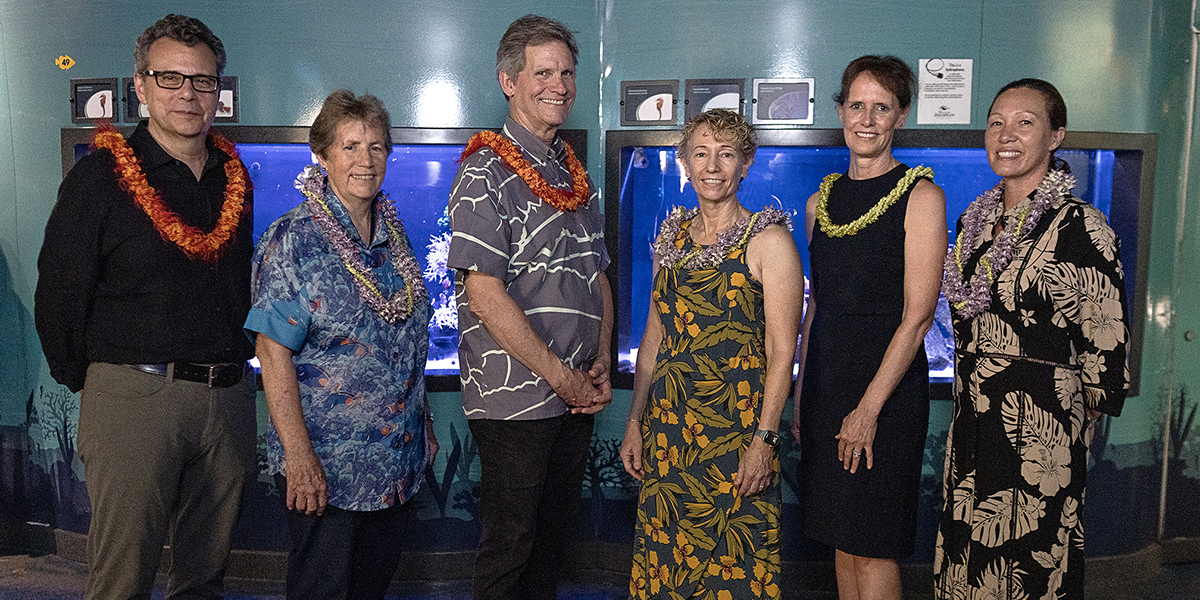
UH Mānoa experts took center stage at the Waikīkī Aquarium for "Ocean Futures: Hawaiʻi Leading the Way," a 65-minute panel discussion that brought together scientists and community leaders to highlight the research, policy and education helping Hawaiʻi understand and respond to a changing ocean and climate. Throughout the evening, speakers returned to a central message: while environmental challenges are growing, so is the University of Hawaiʻi’s momentum to address them.
The discussion opened on a note of optimism, with panelists Dean Chip Fletcher of the School of Ocean and Earth Science and Technology (SOEST), Assistant Professor and UH alumna Andrea Kealoha and Suzanne Case, Director of the UH Office of Land and Ocean Conservation Futures, emphasizing the promise of the next generation of ocean and environmental scientists and the importance of sustained collaboration across disciplines and communities.
“Hawai‘i is at the forefront of aquarium science,” said Judy Lemus, acting Director of the Waikīkī Aquarium and Associate Dean of SOEST. “We embrace our commitment to conservation. Without research and education, we would not have the window to the ocean world. And the animals are the ambassadors to that world.”
Serving as moderator, UH Mānoa Chief Academic Advancement Officer Margaret McManus framed the evening’s purpose, underscoring the deep connection between Hawaiʻi and the ocean.
“Ocean Futures – because the ocean is not background to life in Hawaiʻi. It is life in Hawaiʻi,” McManus said. “It is our weather, our food, our economy, our culture and our identity. What happens to the ocean happens to us.”
McManus also highlighted the university’s role in addressing global environmental challenges. “Hawaiʻi Leading the Way – because we are not simply on the receiving end of a global crisis,” she added. “UH is generating the science, the policy frameworks and the community solutions that the world needs.”
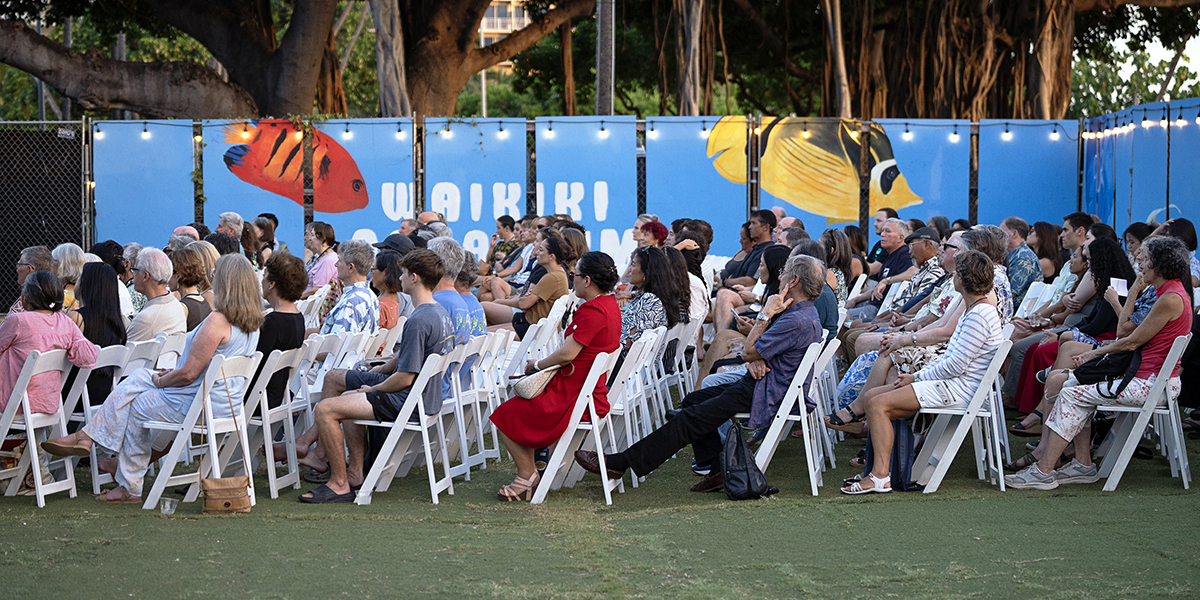
Attendees learned how the next generation of scientists is generating the cutting-edge research, policy frameworks, and actionable conservation solutions the world desperately needs.
UH Mānoa incoming Chancellor Vassilis Syrmos formally welcomed attendees, reinforcing the university’s responsibility as a leading research institution in the Pacific.
“As a premier research institution surrounded by the Pacific, UH Mānoa bears a unique responsibility to lead in marine and climate sciences,” Syrmos said. “We are proud to partner with the Waikīkī Aquarium to showcase how our academic community is translating cutting-edge research into actionable solutions for Hawaiʻi and the world.”
Held in partnership with the UH Foundation, the evening provided a unique opportunity for people in the audience to connect directly with the science and policy, hearing firsthand about the critical research and climate solutions their philanthropy helps bring to life.
The program’s scientific foundation was set by a featured presentation from Fletcher, who outlined the interconnected nature of environmental systems and the urgency of ongoing changes already affecting Hawaiʻi.
“The future arrives quietly,” Fletcher said. “King tides, drought, wildfires, coral reef bleaching – it’s all here. The system is under stress and unpredictable, and Hawaiʻi is at the frontline.”
He emphasized that addressing these challenges requires a broad, integrated approach across scientific disciplines, pointing to ongoing research into shifts in weather patterns, trade winds and cloud formation as critical to understanding local impacts.
Kealoha added a community-centered perspective, stressing the importance of representation and mentorship in the sciences. She noted that Indigenous knowledge and lived experience are essential to shaping effective solutions.
“As the sciences diversify, so will the perspectives and solutions we develop to address our ocean challenges,” Kealoha said. “I am probably one of only a handful of Native Hawaiians with a PhD in oceanography. In 10 or 15 years, that number could double or triple, and that will strengthen our communities’ resilience.”
Kealoha encouraged students to pursue careers in ocean and environmental science and to seek mentors while also supporting future generations.
Closing the panel, Case addressed the importance of aligning scientific research with policy and community knowledge.
“We must weave together the rigorous science being developed here at the university with the deep, generational knowledge of our communities,” Case asserted. “By creating policy frameworks that respect both modern data and Indigenous practices, we can fulfill our shared kuleana (responsibility) to protect Hawaiʻi's natural environment for generations to come.”
Together, the panelists underscored a shared vision: that Hawaiʻi’s leadership in ocean science, combined with community engagement and cultural knowledge, positions the state as both a frontline observer and a source of solutions in addressing global environmental change.
Questions? / More Information
If you would like to learn how you can support UH students and programs like this, please contact us at 808-956-8700 or send us a message.