

Naima Te Maile Fifita recalls the time, as a 15-year-old sophomore in high school, when she asked her Tuvaluan grandpa how he felt if Tuvalu was to disappear one day due to a climate disaster. Taking a moment to respond, he simply said, “Tuvalu will never be gone.”
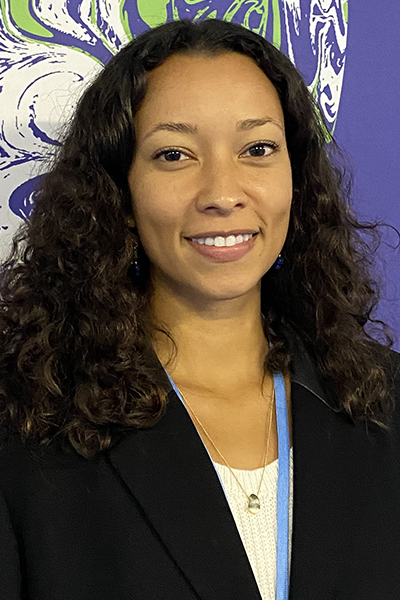 “I just let that hang there because I wasn’t quite sure what he meant,” Fifita recalls. “Did he mean, will it only exist underwater, and the island will still be intact and be there like a 21st century Atlantis? Or, did he mean that the spirit of the Tuvaluan people and islands would never cease to exist?”
Since that exchange with her tutu, Fifita has been on a path to find the true meaning of his words, and she finally got the answer after attending the 26th United Nations Climate Change Conference of the Parties (COP26) in Glasgow, Scotland.
“I now believe he was suggesting that I do the work to help Tuvalu and the other Pacific Island nations,” asserts Fifita, who earned her Juris Doctor from the William S. Richardson School of Law in 2023. “So when I attended the conference in Glasgow, it was my personal mission to connect with the precious delegation of Tuvaluans who were in attendance.”
Chance meeting
Speaking with a tone of urgency, Fifita discussed the existential threat facing Tuvalu with the delegates, led by Finance Minister Hon. Seve Paeniu. Although she met Paeniu by mere happenstance on a bus on her way back to her lodgings, she later learned that his spouse, Malama, was her auntie.
“They invited me to dinner that evening, and I got to ask Seve many questions, but his responses to two of them will always stay with me,” Fifita says.
“One of the questions I asked him was if he agreed to the drowning island rhetoric that was often heard in conversations about Tuvalu and other small island states, and their plight against the climate crisis.
“He said that he did because that was what he was beginning to see on a regular basis where he lived in Funafuti, which is the capital of Tuvalu,” Fifita adds.
“He told me how during the storm season he would see tides build on one side of the island and crash down on the other, and he had never seen that before, so it was really concerning for him.”
Lifetime passion
Fifita considers COP26 as a springboard for her career as a climate advocate. Currently the executive director of Institute for Climate & Peace, she realized during the summit that there was so much potential for Tuvaluans and other Pacific Islanders to have a deeper understanding of the nuances and complexities that climate change/law entails.
Educational travel
Ted and Catherine Mieko Pettit commend Fifita for her unwavering dedication to environmental issues and funded the scholarship that allowed her to attend COP26.
“To see the impact that the summit has had, not just only on Naima, but on so many others who went, is priceless,” says Ted Pettit (JD ’86, PhD ’80 Mānoa). “It’s a kinship that has formed with like-minded people who are thinking about a problem that seems hopeless.”
Not to Fifita and her league of advocates and warriors who are leading the battle to lower emissions and fossil fuels to ensure the ecological future for the next generation of stewards.
Now living in New Zealand, Fifita’s advocacy for climate justice continues to be informed by her passion for the environment. And she presses on to amplify the voices of Pasifika communities and the perils that affect their daily lives.
Worldwide network
“Being able to attend COP26 made a real impression on Naima,” says Catherine Pettit (MA ’97, BA ’71 Mānoa). “Until we read about her in the William S. Richardson School of Law’s bi-monthly newsletter, Ted and I didn’t realize how far she had gone. The exposure she received and the connections she made at COP26 have helped her in her advocacy work.”
Naima is a great example, Ted Pettit says, of why they initially established the Pettit Family Law Student Travel Endowment Fund, which helps aspiring lawyers to meet travel expenses incurred while attending conferences, presenting papers, conducting research, and participating in educational activities.
“It’s not just that travel impacts your life as a student, it’s something that you carry with you throughout your life,” Ted Pettit says. “Things that you never imagined you would be doing are solidified by your travel experiences.”
For Fifita, the Glasgow summit confirmed her beliefs that more representation and platforms are needed so that indigenous peoples’ voices can not only be heard, but also be influential in implementing, drafting and negotiating policies and agreements that impact small island nations.
“I think attending COP26 opened so many doors for me,” says Fifita, who started her master’s in international law at University of Otago in March. “It brought entire clarity to my career, and what it means to contribute to humanity and my community on a global scale.”
Your generosity makes a lasting impact on our students, faculty, and community. Join us in supporting this important work.
Questions? / More Information
If you would like to learn how you can support UH students and programs like this, please contact us at 808-956-8700 or send us a message.