
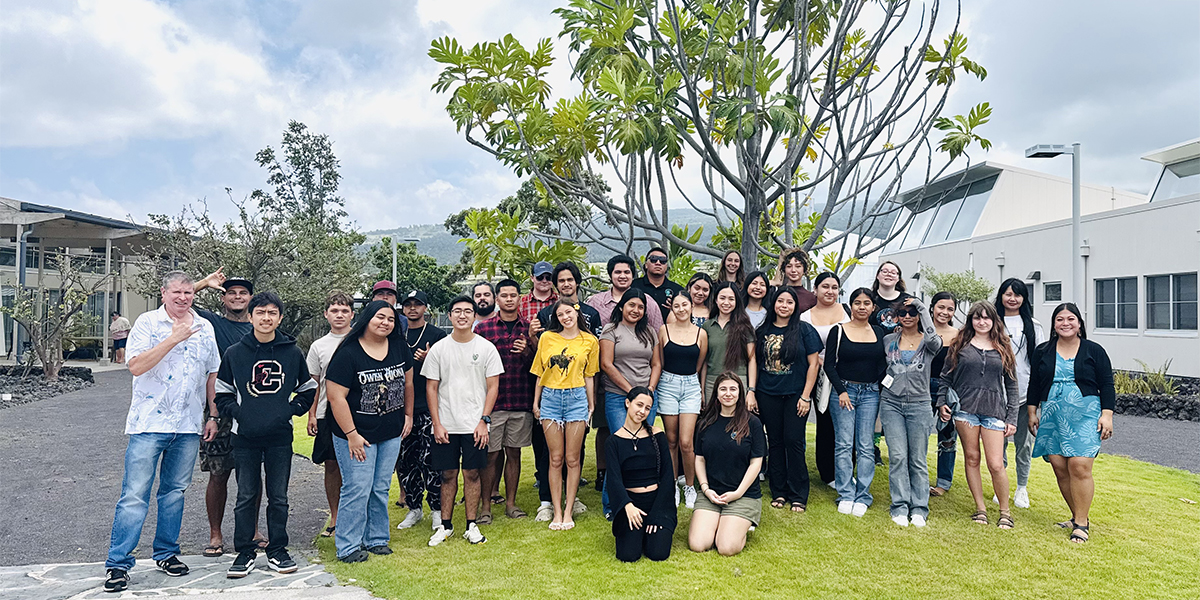
When Hawaiʻi Community College student Blake Pena-Perez wakes up each morning, it isn’t in a dorm room or an apartment in Pālamanui. It is in the back of his 2009 Toyota Sienna van.
“I grew up in foster homes, surrounded by drugs, alcohol and chaos,” said Pena-Perez, a first-generation freshman and recipient of the Ēlama and Hilo One (pronounced O-nay) scholarships. “There were times I didn’t think I’d make it out. But I always believed education could be my way forward.”
For Pena-Perez and many UH students, the path to higher education is a delicate balance between ambition and survival. A recent UH study on student basic needs insecurity surveyed 2,704 students across all 10 campuses, revealing stark realities: 60% experienced food insecurity, 25% faced housing instability and nearly one in three skipped medical care due to cost.
“There were days I didn’t know what I’d eat,” Pena-Perez recalled. “That kind of stress takes over your whole life. The Ēlama scholarship reminded me that I’m not alone – that there are people out there who truly care about students like me.”

Charlee Rowe with her late dad Raymond “Lana” Rowe, who was awarded the Daniel R. Sayre Memorial Foundation Award for his work as a Battalion Chief at Waiakea Fire Station.
Beyond Statistics: Faces of Resilience
At Hawaiʻi CC’s Pālamanui campus, donor support is helping students rise above these challenges.
“We’ve reached a record 83 students in the Ēlama program this year, with 55 directly supported by The Kirk-Landry Charitable Fund,” said Kalei Haleamau-Kam, director at Hawaiʻi CC–Pālamanui. “This support is changing lives and it’s giving students the chance to pursue higher education when, for many, it once felt out of reach.”
Charlee Rowe, a 32-year-old first-year student, knows this reality well. After high school, she worked on a production line but knew it wasn’t where she wanted to stay. When her late father, Raymond “Lana” Rowe, a retired Hawaiʻi Battalion Chief, was diagnosed with lung cancer, she took on the role of caregiver – a life-changing experience that inspired her to pursue healthcare.
“Watching my dad go through his illness showed me how important compassionate care is,” Rowe said. “It gave me a purpose beyond myself.”
Always cautious about college costs, Rowe postponed the decision to attend for more than a decade until she learned about the Ēlama Scholarship.
“Without the scholarship, I might have taken a class or two before giving up,” she said. “It’s given me stability and hope, and now I can truly see a future in nursing.”
Compassion in Action
“Gifts from donors help support the Ēlama and Hilo One programs,” said Ēlama counselor-in-charge Precious Mae Atendido. “This semester alone, we’ve helped students who didn’t know where their next meal would be coming from. We were able to help them right away.”
For Caroline Landry, every student deserves a chance at higher education. “You have children who don’t really have a roadmap for how to navigate college,” she said. “But if you can somehow make it possible and support them through just the first year of college, it can change everything. That’s why we call it the 13th year of high school, which is the Ēlama program. It involves wraparound support, mentoring and peer mentoring.”
The impact of achieving an AA degree is significant. According to a 2023-2024 UH Economic Research Organization study by Timothy Halliday and Rachel Inafuku, lifetime earnings for AS and AAS degree holders are $2.7 million, which is 22% higher than earnings for those who leave the program without a degree.
“A donor can hear my thanks and see my smile,” said Perez-Pena, “but the meaningfulness of their gift goes a lot deeper than words and facial expressions. It has changed the trajectory of my entire life. I plan to get my associate degree and then continue my education – maybe even get my PhD.”
Landry points out that for many students, it’s not just a single barrier but a series of challenges that stand in the way of attending college. “So, if you remove the barriers for these students to go through the first year of college,” she said, “chances are there will be second, third and fourth years.”
Questions? / More Information
If you would like to learn how you can support UH students and programs like this, please contact us at 808-956-8700 or send us a message.